How Is Netherlands Art Have a Relationship With Renaissance
The Renaissance in the Low Countries was a cultural catamenia in the Northern Renaissance that took place in around the 16th century in the Low Countries (corresponding to modern-twenty-four hour period Belgium, kingdom of the netherlands and French Flanders).
Culture in the Low Countries at the end of the 15th century was influenced past the Italian Renaissance, through trade via Bruges, which fabricated Flemish region wealthy. Its nobles commissioned artists who became known across Europe. In science, the anatomist Andreas Vesalius led the way; in cartography, Gerardus Mercator's map assisted explorers and navigators. In art, Dutch and Flemish Renaissance painting went from the strange work of Hieronymus Bosch to the everyday life of Pieter Brueghel the Elder. In architecture, music and literature too, the culture of the Low Countries moved into the Renaissance style.
Geopolitical situation and background [edit]
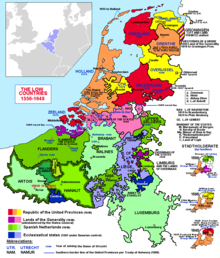
Map showing the political state of affairs in the Low Countries between 1556 and 1648.
In 1500, the Seventeen Provinces were in a personal marriage under the Burgundian Dukes, and with the Flemish cities as centers of gravity, culturally and economically formed one of the richest parts of Europe. During the course of the century the region likewise experienced meaning changes. Humanism and Reformation led to a rebellion against the Spanish dominion of Philip Two of Espana and the get-go of the religious war. Past the end of the 16th century the Northern and Southern Netherlands were effectively split. While this fracture was reflected in the visual arts past the Dutch Golden Age in the north and the Flemish Baroque in the south, other areas of thought remained associated with 16th-century currents of Renaissance thought. Gradually, the balance of power shifted away from the Southern Netherlands, which remained under Spanish authority, to the emerging Dutch Republic.[1]
Two factors determined the fate of the region in the 16th century. The outset was the union with the kingdom of Spain through the 1496 union of Philip the Handsome of Burgundy and Juana of Castile. Their son, Charles V, built-in in Ghent, would inherit the largest empire in the world, and holland, although a prominent part of the empire, became dependent on a big strange power.
A second gene included religious developments. The Eye Ages gave way to new modes of religious thinking. Devotio Moderna practices, for example, were particularly strong in the region, while the 16th-century criticisms of the Cosmic Church that spread throughout Europe also reached the Depression Countries. Humanists such as Desiderius Erasmus of Rotterdam were critical only remained loyal to the church. However, the spread of the Protestant Reformation, started by Martin Luther in 1517, somewhen led to outright war. The Reformation, particularly the ideas of John Calvin, gained significant support in the Low Countries, and post-obit the 1566 iconoclastic outbreaks Spain attempted to quell the tide and maintain the authority of the postal service-Tridentine Church through force by installing Fernando Álvarez de Toledo, Duke of Alba.[2] The repression that followed led to the Dutch Defection, the beginning of the Fourscore Years State of war, and the establishment of the Dutch Republic in the northern provinces. Later, the Southern Netherlands became a bastion for the Counter Reformation, while Calvinism was the main religion of those in ability in the Dutch Republic.
Influence of the Italian Renaissance [edit]

Trade in the port of Bruges and the textile industry, mostly in Ghent, turned Flanders into the wealthiest role of Northern Europe at the stop of the 15th century. The Burgundian court dwelled mostly in Bruges, Ghent and Brussels. The nobles and rich traders were able to commission artists, creating a form of highly skilled painters and musicians who were admired and requested around the continent.[3]
This led to frequent exchanges betwixt the Depression Countries and Northern Italian republic. Examples are Italian architects Tommaso Vincidor and Alessandro Pasqualini, who worked in the Low Countries for most of their careers, Flemish painter Jan Gossaert, whose visit to Italy in 1508 in the company of Philip of Burgundy left a deep impression,[1] musician Adrian Willaert who made Venice into the most important musical centre of its time[three] (see Venetian School) and Giambologna, a Flemish sculptor who spent his most productive years in Florence.
Before 1500, the Italian Renaissance had little or no influence above the Alps. Later this we brainstorm to see Renaissance influences, but different the Italian Renaissance, Gothic elements remain important. The revival of the classical catamenia is also not a primal theme similar in Italy, the "rebirth" shows itself more as a render to nature and earthly beauty.[three]
Renaissance in the Low Countries [edit]
Art [edit]
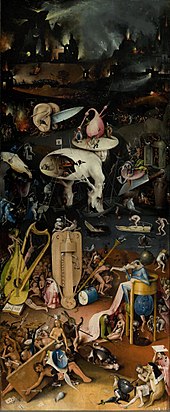

Fifteenth-century painting in the Depression Countries still shows stiff religious influences, reverse to the Germanic painting. Even subsequently 1500, when Renaissance influences begin to show, the influence of the masters from the previous century leads to a largely religious and narrative style of painting.
The first painter showing the marks of the new era is Hieronymus Bosch. His work is strange and total of seemingly irrational imagery, making information technology difficult to interpret.[1] Nigh of all information technology seems surprisingly mod, introducing a earth of dreams that highly contrasts with the traditional style of the Flemish masters of his day.
After 1550, the Flemish and Dutch painters brainstorm to prove more interest in nature and in dazzler an sich, leading to a style that incorporates Renaissance elements, merely remains very far from the elegant lightness of Italian Renaissance art,[3] and directly leads to the themes of the slap-up Flemish and Dutch Bizarre painters: landscapes, still lifes and genre painting – scenes from everyday life.[i]
This development is seen in the works of Joachim Patinir and Pieter Aertsen, but the truthful genius among these painters was Pieter Brueghel the Elder, well known for his depictions of nature and everyday life, showing a preference for the natural condition of man, choosing to depict the peasant instead of the prince.
The Landscape with the Fall of Icarus, now thought to be an early on copy, combines several elements of northern Renaissance painting. It hints at the renewed interest for antiquity (the Icarus legend), just the hero Icarus is hidden away in the background. The master actors in the painting are nature itself and, nearly prominently, the peasant, who does non even look upwards from his turn when Icarus falls. Brueghel shows man as an anti-hero, comical and sometimes grotesque.[3]
Compages and sculpture [edit]
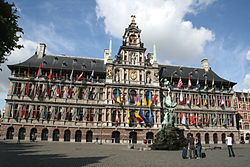
Equally in painting, Renaissance architecture took some fourth dimension to attain the High Countries, and did not entirely supercede the Gothic elements. The nearly important sculptor in the Southern Netherlands was Giambologna, who spent most of his career in Italy. An builder direct influenced past the Italian masters was Cornelis Floris de Vriendt, who designed the metropolis hall of Antwerp, finished in 1564.

Sluter, The Well of Moses, 1395-1405
In sculpture, still, 15th-century Netherlandish artists, while adhering to Christian subjects, developed techniques and a naturalistic style which compares favorably to the work of early on-Renaissance Italian contemporaries such as Donatello. Claus Sluter (fl. ~1400) produced works such as the Well of Moses with a dynamism well-nigh unknown at the turn of the 15th century; and Dutch-born Nikolaus Gerhaert van Leyden (b. ~1420) made sculptures such as "Homo Meditating", which even today announced more than "modern" than does Italian Quattrocento carving.
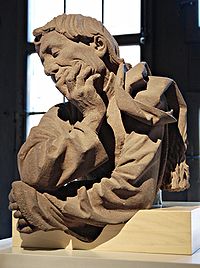
Gerhaert, Man Meditating, 1467
In the early on-17th century Dutch Republic, Hendrick de Keyser plays an important role in developing the Amsterdam Renaissance style, non slavishly following the classical style but incorporating many decorative elements, giving a result that could also be categorized as Mannerism. Hans Vredeman de Vries was some other important proper name, primarily as a garden architect.
Music [edit]

While in painting the Depression Countries were leading Northern Europe, in music the Franco-Flemish or Dutch School dominated all of Europe. In the early Renaissance, polyphonic music composers from the Low Countries such every bit Johannes Ciconia were working at all the European courts and churches. Educated in the church and cathedral schools of their own region, they spread out and would bring their manner to the whole continent, so that by the tardily Renaissance a unified musical manner emerged throughout Europe.[three]
Although there is no reference to antiquity, there is a clear Flemish "Renaissance consciousness", as indicated by the words of Flemish theorist Johannes Tinctoris, who said of these composers: "Although it is across belief, naught worth listening to had been composed before their fourth dimension".[ane]
Renaissance elements in the music are the render from the "divine origin" of music to earthly dazzler and sensory joy. The music becomes more structured, balanced and melodic. Whereas in the Middle Ages the choice of instruments was free, composers now start to organize instruments into homogeneous groups, and write music specifically for certain arrangements.[iii]
Josquin des Prez was the most celebrated composer during the High Renaissance, and during his career enjoyed the patronage of three popes. Equally at ease in secular and religious music, he can be considered the first musical genius we know of.[1]
Other important composers from the Low Countries were Guillaume Dufay, Johannes Ockeghem, Jacob Clemens non Papa and Adrian Willaert. Orlande de Lassus, a Fleming who had lived in Italy as a youth and spent most of his career in Munich, was the leading composer of the late Renaissance.
Literature [edit]
In the middle of the 16th century, a group of rhetoricians (run across Medieval Dutch literature) in Brabant and Flanders attempted to put new life into the stereotyped forms of the preceding age by introducing in original composition the new-establish branches of Latin and Greek poetry. The leader of these men was Johan Baptista Houwaert, who was led by an unbounded beloved of classical and mythological fancy.[4]
The most important genre was music publishing, specially psalms. The Souterliedekens publication is one of the most important sources for the reconstruction of Renaissance folksongs. After publishing was heavily influenced by the rebellion against the Spanish: heroic boxing songs and political ballads ridiculing the Spanish occupants.
Best remembered of the writers is Philips van Marnix, lord of Sint-Aldegonde, who was one of the leading spirits in the war of Dutch independence. He wrote a satire on the Roman Catholic Church, started to work on a Bible translation and allegedly wrote the lyrics to the Dutch national canticle.
Other important names are Dirck Volckertszoon Coornhert, Hendrick Laurensz. Spieghel and Roemer Visscher. Inevitably, their works and career were very much determined by the struggle between Reformation and the Catholic Church building.
Science [edit]
The new age presents itself in science every bit well. Flemish anatomist Andreas Vesalius's life typically shows both the new possibilities and the troubles that came with them. He delivered ground-breaking work on human beefcake, subsequently centuries of disregard for it. This earned him nifty respect from some, but also caused several enquiries into his methods (dissection of the homo body) and the religious implications of his piece of work.
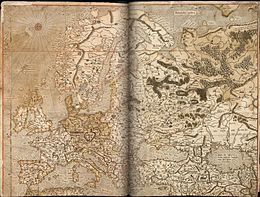
While Vesalius performed ground-breaking work in rediscovering the homo body, Gerardus Mercator, as 1 of the leading cartographers of his time, did the same for rediscovering the outside world. Mercator too came into problem with the Church building because of his behavior, and spent several months in jail afterward a conviction for heresy.
Both scientists' lives show how the Renaissance scientist is non afraid of challenging what has been taken for granted for centuries, and how this leads to issues with the all-powerful Catholic Church.
Though the invention of the press press by Laurens Janszoon Coster in the 1430s appears to be a romantic notion, the Depression Countries had an early start in printing. By 1470 a press printing was in use in Utrecht, where the start dated extant book was printed in 1473, while the beginning volume in the Dutch language was the 1477 Delft Bible. By 1481 the Low Countries had printing shops in 21 cities and towns.[five] Famous publishing houses like those of Christoffel Plantijn in Antwerp from 1555 on, Petrus Phalesius the Elder in Leuven from 1553, and the House of Elzevir in Leiden from around 1580 turned the Low Countries into a regional centre of publishing.
See as well [edit]
- English Renaissance
- French Renaissance
- German Renaissance
Political state of affairs [edit]
- Burgundian Netherlands
- Seventeen Provinces
- Dutch Democracy – Dutch Golden Age
- Eighty Years' War
Arts [edit]
- Flemish painting
- Romanism (painting)
- List of Flemish painters
- Listing of Dutch painters
References [edit]
- ^ a b c d e f Janson, H.W.; Janson, Anthony F. (1997). History of Fine art (fifth, rev. ed.). New York: Harry Northward. Abrams, Inc. ISBN0-8109-3442-6.
- ^ Kamen, Henry (2005). Kingdom of spain, 1469–1714, A Society of Conflict (3rd ed.). Harlow, Great britain: Pearson Pedagogy. ISBN0-582-78464-6.
- ^ a b c d eastward f g Heughebaert, H.; Defoort, A.; Van Der Donck, R. (1998). Artistieke opvoeding. Wommelgem, Belgium: Den Gulden Engel bvba. ISBN90-5035-222-7.
- ^ One or more of the preceding sentences incorporates text from a publication now in the public domain:Gosse, Edmund William (1911). "Dutch Literature § Houwaert". In Chisholm, Hugh (ed.). Encyclopædia Britannica. Vol. 8 (11th ed.). Cambridge University Press. p. 721.
- ^ E. L. Eisenstein: The Printing Revolution in Early Mod Europe, Cambridge, 1993 pp.xiii–17, quoted in: Angus Maddison: Growth and Interaction in the World Economy: The Roots of Modernity, Washington 2005, p.17f.

Source: https://en.wikipedia.org/wiki/Renaissance_in_the_Low_Countries
0 Response to "How Is Netherlands Art Have a Relationship With Renaissance"
Post a Comment