Chances of Having Down Syndrome Baby at 30
Information and Statistics on Down's syndrome
In contempo years, Down's syndrome has become more common, and children with Down syndrome are living longer. Read below for recent statistics on Downwards syndrome in the United States.
How many people are living with Down's syndrome in the U.s.a.?
Babies:
- Down's syndrome continues to be the nearly common chromosomal disorder. Each year, virtually 6,000 babies are born with Down's syndrome, which is about i in every 700 babies built-in.
[Read summaryexternal icon] - Between 1979 and 2003, the number of babies born with Down's syndrome increased by about xxx%.
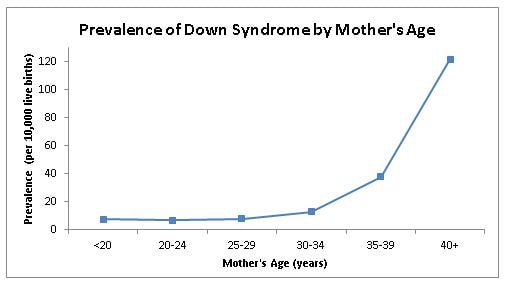
[Read summaryexternal icon ] - Older mothers are more likely to take a baby afflicted by Downward syndrome than younger mothers. In other words, the prevalence of Down syndrome increases as the mother's age increases. Prevalence is an approximate of how often a status occurs among a sure grouping of people. To gauge the prevalence of Down's syndrome, the number of pregnancies afflicted by Down syndrome is compared to the total number of alive births.
[Read summaryexternal icon ]
Children and Adults:
- In 2002, nigh 1 out of every ane,000 children and teenagers (0 to nineteen years former) living in the United States had Down syndrome. This means that in 2002 near 83,000 children and teenagers were living with Down syndrome.
[Read summaryexternal icon ] - Researchers estimated that in 2008 about 1 out of every ane,200 people (children, teens, and adults) living in the Us had Down's syndrome. This means that in 2008 about 250,700 children, teens, and adults were living with Down syndrome in the United States.
[Read summaryexternal icon ]
What is the life expectancy for people with Downward syndrome?
- The life expectancy of people with Down syndrome increased dramatically between 1960 and 2007. In 1960, on average, persons with Downwardly syndrome lived to exist about 10 years former. In 2007, on boilerplate, persons with Down syndrome lived to exist virtually 47 years former.
[Read summaryexternal icon ] - Many factors can touch how long a person with Downwards syndrome lives.
- Sometimes infants with Down syndrome are born weighing less than one,500 grams, or about 3.3 pounds. This is chosen "very depression birth weight." These babies are 24 times more probable to die in the starting time 28 days of life compared to infants with Down's syndrome of normal birth weight (between two,500 grams and 4,000 grams, or between 5.five and eight.8 pounds).
[Read summaryexternal icon ] - Black or African-American infants with Down syndrome accept a lower hazard of surviving beyond the get-go year of life compared with white infants with Down syndrome. More enquiry is needed to help understand why.
[Read summaryexternal icon ] - Infants with Down's syndrome who also had a congenital heart defect (CHD) were five times more likely to dice in the offset year of life compared to infants with Down syndrome who did non have a CHD.
[Read summaryexternal icon ]
- Sometimes infants with Down syndrome are born weighing less than one,500 grams, or about 3.3 pounds. This is chosen "very depression birth weight." These babies are 24 times more probable to die in the starting time 28 days of life compared to infants with Down's syndrome of normal birth weight (between two,500 grams and 4,000 grams, or between 5.five and eight.8 pounds).
- Between 1983 and 2003, about 93% of babies built-in with Downward syndrome survived to one year of historic period. In the same time flow, well-nigh 88% of babies built-in with Down's syndrome survived to xx years of age.
[Read summaryexternal icon ] - The number of infants with Down syndrome that dice before i year of historic period has declined over time. For example, between 1979 and 2003, among babies with Down syndrome, the rate of death during the first year of life declined from 8.5% to 5.0%, a decrease of about 41%. For comparing, the rate of decease during the first year of life among all babies in the general population declined from 1.5% during 1979-1983 to 0.9% during 1999-2003, a subtract of about 40%.
[Read summaryexternal icon ]
What other health conditions affect people with Downwardly syndrome?
- About fifty% of all babies born with Down's syndrome are also born with a built middle defect. Babies with Down syndrome can exist affected past a wide variety of heart defects. Many of these conditions will need surgery, while some milder center defects might go away on their own as the child grows and may just need to be monitored by a healthcare provider.
[Read summaryexternal icon ] - Compared to children without Down's syndrome, children with Down syndrome are at college risk for:
- Hearing loss (upwardly to 75% may be afflicted)
- Obstructive sleep apnea, a condition where a person's breathing temporarily stops while comatose (between 50 -75%)
- Ear infections (between fifty -70% may exist affected)
- Centre diseases, like cataracts (upward to 60%)
- Eye bug requiring spectacles (50%)
- Heart defects present at birth (fifty%)
- Intestinal blockage at nascency requiring surgery (12%)
- Hip dislocation (when the thigh os slips out of the hip socket) (6%)
- Thyroid illness (a problem with metabolism) (4-18%)
- Anemia (red blood cells can't carry enough oxygen to the body) (3%)
- Iron deficiency anemia (ruddy blood cells don't accept enough atomic number 26 to carry oxygen to the torso) (10%)
- Leukemia (1%) in infancy or early on babyhood
- Hirschsprung disease (an illness of the gut that can cause constipation) (<1%)This commodity includes the American University of Pediatrics Health Supervision for children with Downward syndrome from 2011.
[Read summaryexternal icon ]
For more wellness care information for families of children with Down's syndromeexternal icon
- Older adults with Down's syndrome have increased adventure for developing Alzheimer's affliction.
[Read summaryexternal icon ]
What are the healthcare needs and costs for people with Down syndrome?
- Amid children aged 0-4 years with private insurance, boilerplate medical care costs were 12 times higher for children with Down's syndrome compared to children of the aforementioned age without Down syndrome.
[Read summaryexternal icon ] - For infants with Down syndrome, those born with a eye defect had, on average, wellness care costs that were 5 times higher in the showtime year of life than for infants with Down syndrome who did not have a heart defect.
[Read summaryexternal icon ] - A written report used data from the 2005-2006 National Survey of Children with Special Healthcare Needs (NSCSHN) to look at the effects of Down syndrome on families. Responses from the NSCSHN questionnaire indicated the post-obit:
- Well-nigh sixty% of families of children with Down's syndrome provided health care at abode. Health care included practices such as changing bandages, care of feeding or breathing equipment, and giving medication and therapies.
- Over 40% of families of children with Downwardly syndrome had a family member who stopped working because of the child's condition.
- Nearly 40% reported the child'southward condition caused financial problems.
[Read summaryexternal icon ]
Source: https://www.cdc.gov/ncbddd/birthdefects/downsyndrome/data.html
0 Response to "Chances of Having Down Syndrome Baby at 30"
Post a Comment